Donald Squier
Donald was the son of Albert Squier who was a well known travel photographer and lecturer. Albert Squier's first career was as a Methodist minister. He earned his theology degree at Wesleyan University. As a young minister he preached in Fitchburg and Cambridge Massachusetts and was considered the best orator in the Eastern Conference. Albert was a man of considerable presence. He was six foot tall, had black hair and a melodious speaking voice. Unfortunately his charm and good looks led to his downfall as a minister. Scandal led to a divorce and his separation from both the church and his family.
Donald was the son of Albert Squier who was a well known travel photographer and lecturer. Albert Squier's first career was as a Methodist minister. He earned his theology degree at Wesleyan University. As a young minister he preached in Fitchburg and Cambridge Massachusetts and was considered the best orator in the Eastern Conference. Albert was a man of considerable presence. He was six foot tall, had black hair and a melodious speaking voice. Unfortunately his charm and good looks led to his downfall as a minister. Scandal led to a divorce and his separation from both the church and his family.
Albert was married to Jessie Ryther of Palmer Massachusetts. She bore him three 3 sons, Donald , Leonard and Roger. Young Donald loved to draw. When Alice and Melville Bigelow, who attended Albert's church in Cambridge, visited the Squier home they saw young Donald's drawings and offered to pay for art lessons for the boy. Alice was a devoted patron and friend of Donald's until her death in 1953. The Bigelows paid for his first year at the Museum School at the Boston Museum of Fine Arts. After that he attended on Scholarship until he felt he had learned everything he could from the teachers there.
When World War I broke out Donald joined the cavalry. He was sent to the Texas Mexican border where he spent the war chasing Pancho Villa back and forth across the Mexican border. When Donald left the cavalry as a first lieutenant, he traveled back East to resume his studies in art. He decided he needed the European experience and sailed steerage to Europe. He studied independently in Paris and was very impressed with the new art which he experienced.
When he returned to Boston, he tried to sell his new work and found it soundly rejected by the then reigning arts community. Since he needed money to live, he started doing portraits which he had been very successful at while in art school. Melville Bigelow was the Dean of Boston University Law School and was able to introduce the young artist to the social circles in which he could sell portraits. This work led him to portrait commissions in Washington DC and New York.
In Washington during the 20s and 30s he was much in demand and painted many political notables of the era, among them was Chief Justice Hughes, General George S. Patton, Mrs Henry Parsons Erwin, Hamilton Fish and many too numerous to mention (and too old and tedious for his children to remember).
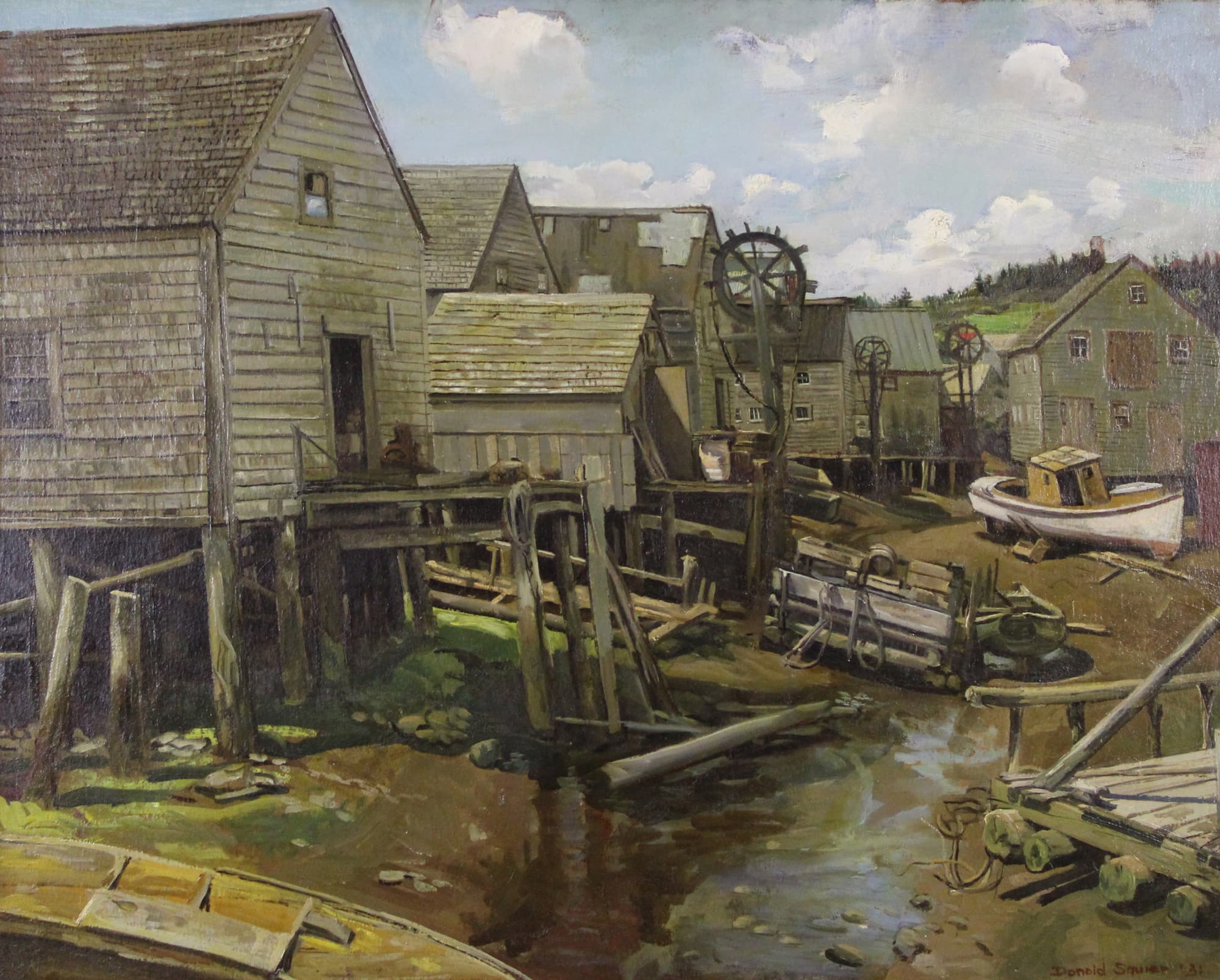
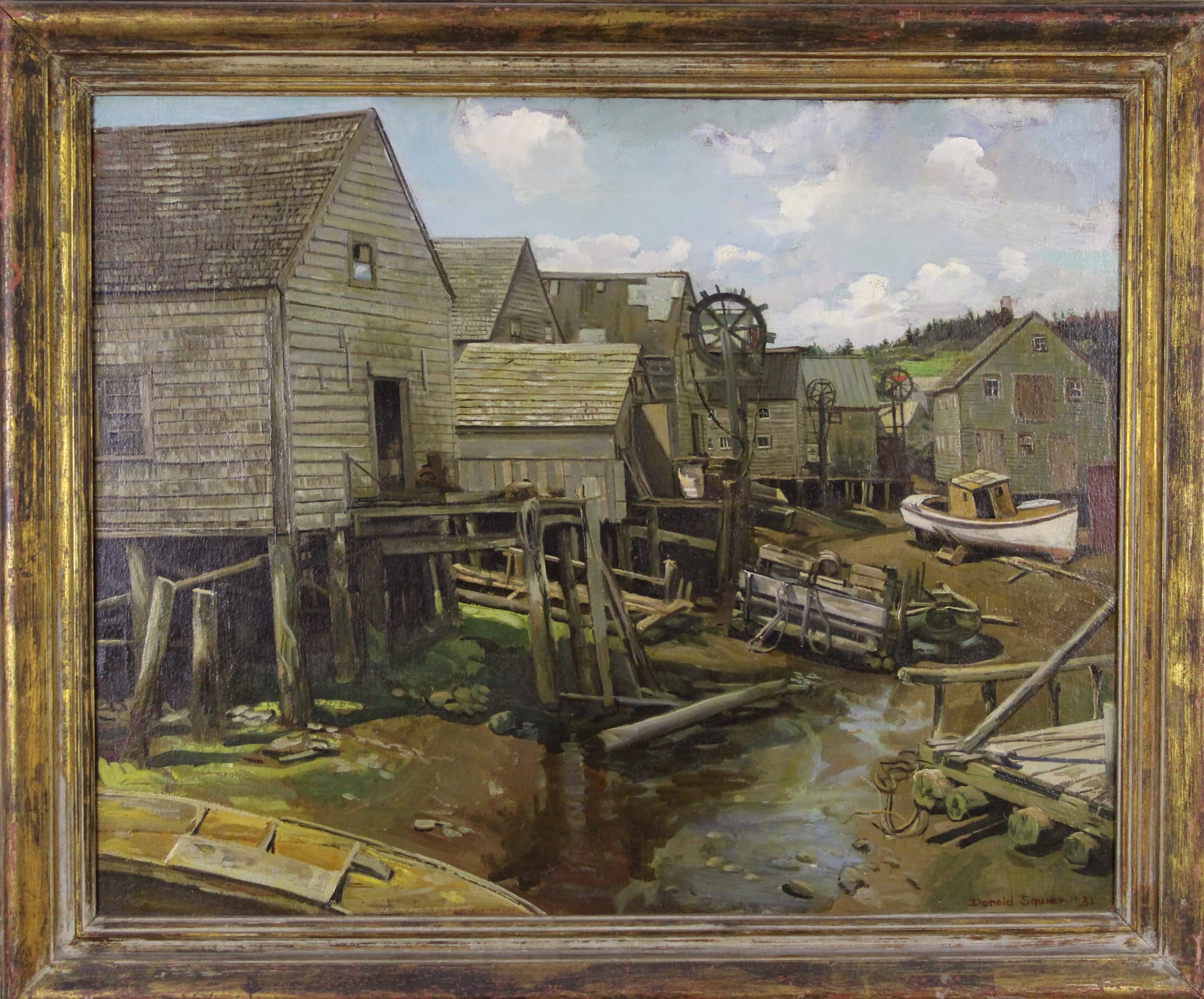
Donald had a studio in Greenwich Village in the late 20's and early 30's. During that time, although known as a portrait painter, he also painted street scenes which he loved. He also traveled to western Massachusetts and New Hampshire and where he painted landscapes. He always loved painting people and nature, but had little interest in the formal recognition and acceptance of the art world. Since he was a successful portrait artist he didn't feel he needed to "play the game" as he called it.
In the 30's Donald Squier's world came to an end. The building which housed his studio was gutted by fire. Donald had collected a number of portraits from clients for a one man show. Every piece disappeared. He felt he had to replace every portrait which had been lost. He worked day and night to recoup and by so doing ruined his health. Although he managed to replace the work, he injured his back so severely that he could not walk. His old patron Alice Bigelow, brought him back to Boston for medical treatment, and gradually he began to regain his mobility. He opened a studio in the Fenway across from Fenway Park and resumed painting. Many of his paintings in the late 30's were murals commissioned by public institutions.
In 1936 he married a young model Evelyn Sinclair. She bore him 4 children in 8 years. When WW II broke out, Donald tried to enlist, but he was considered too old and had too many responsibilities. Since he felt it was his patriotic duty to help in the war effort, he took a job at General Electric designing airplane engines. It was a totally new experience for Donald, and he seemed to enjoy the camaraderie of the work place, so different from the solitary studio environment.
At the end of WW II ,Donald Squier and his family moved to Melrose, Massachusetts. He maintained a studio on the 3rd floor of his home there and continued to paint portraits. Since he no longer traveled in the social circles which generated portrait commissions, he supplemented his portrait work with restorations and other less desirable art work. His loyal patrons continued to offer him portrait commissions, and he painted portraits until the mid 1970's when he experienced two detached retinas. The scaring on his retinas made it impossible for him to see clearly. For all intents and purposes his days as a portrait artist were over, although he did produce a few pieces of friends and family.
Artwork